Images from the archive.
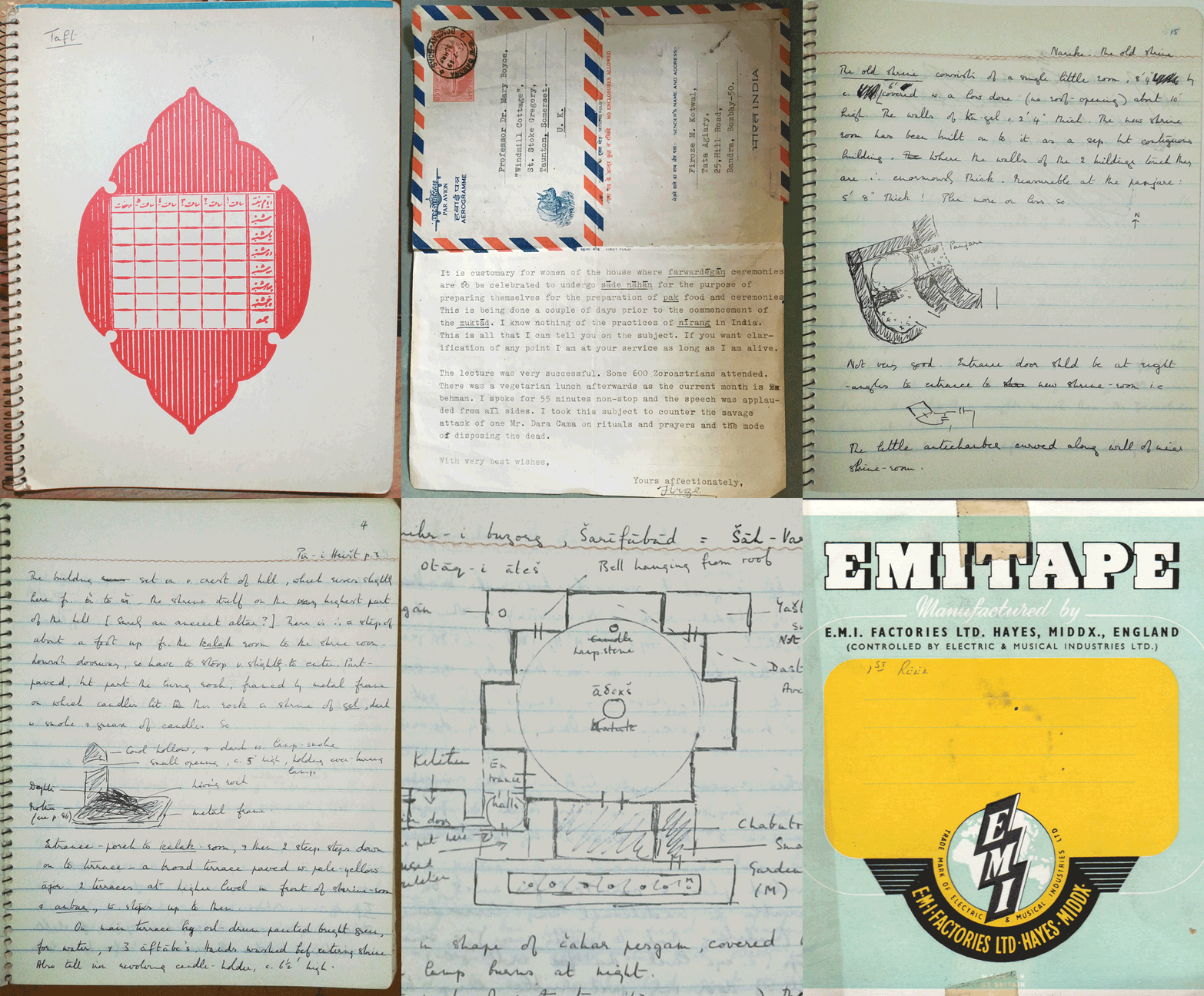
Field work 1963-64
Boyce’s field-work, notably in Šarifābād during 1963-64, transformed her research in many ways. First, she had studied ancient texts from a linguistic perspective, and subsequently encountering devout Zoroastrians stimulated her interest in the religious aspect of their lives.
Second, it transformed her whole perspective of the study and history of the religion. Boyce believed it was critical to understand the way traditions were preserved orally. She developed a theory of the continuity of Zoroastrian belief and practice from the time of the prophet right down to modern times. This led her to conclude that modern practices can shed light on obscure ancient texts, including the Gāthās.
Thirdly, having studied with devout priests, she arrived at new and influential views concerning priesthood—in contrast with received models that were dominated by protestant scholarship of the time. She saw Zoroaster as both teacher and prophet, stressing both his visionary experience and his training as an Indo-Iranian priest, and understanding the Gāthās as in part, at least, meditations on the ritual.
Awards
In recognition of her contributions to the field, Professor Boyce was awarded the Burton Gold Medal of the Royal Asiatic Society in 1972, and in 1985 she was awarded the Sir Percy Sykes Memorial Medal of the Royal Society of Asian Affairs.
Notable Publications
In 1975 she published the first volume of The History of Zoroastrianism, which appeared in the monograph series Handbuch der Orientalistik (Leiden:Brill).
Zoroastrianism: the Rediscovery of Missing Chapters in Man’s Religious History, Teaching Aids for the Study of Inner Asia 6, Bloomington, 1977.
A Persian Stronghold of Zoroastrianism. London: Oxford University Press; 1977, repr. 2001
Textual Sources for the Study of Zoroastrianism Textual Sources for the Study of Religion. London: Rowman & Littlefield. 1984, repr. 1990
Her Ratanbai Katrak lecture series were published in 1977 as A Persian Stronghold of Zoroastrianism.
Field work 1963-64
In collaboration with